Services

One-to-one, team or executive — built around the English your work demands.

Business English training for individuals, teams or whole departments, on-site or online — we always start with the communication challenges people actually face at work.

Tell us about yours
Illustration: three colleagues talk in a sunlit hall, one explaining with an open hand

01 — Ways of working with us

Find the format that fits your people.

For every level — from the first steps in grammar and vocabulary to fluent professionals refining nuance. We also prepare learners for Cambridge and telc business English exams.

Written for you

Materials are written specifically for you — for your company, your field, a task, a skill or a specialised vocabulary set — using your own documents, our research and our expertise.

Session snapshots

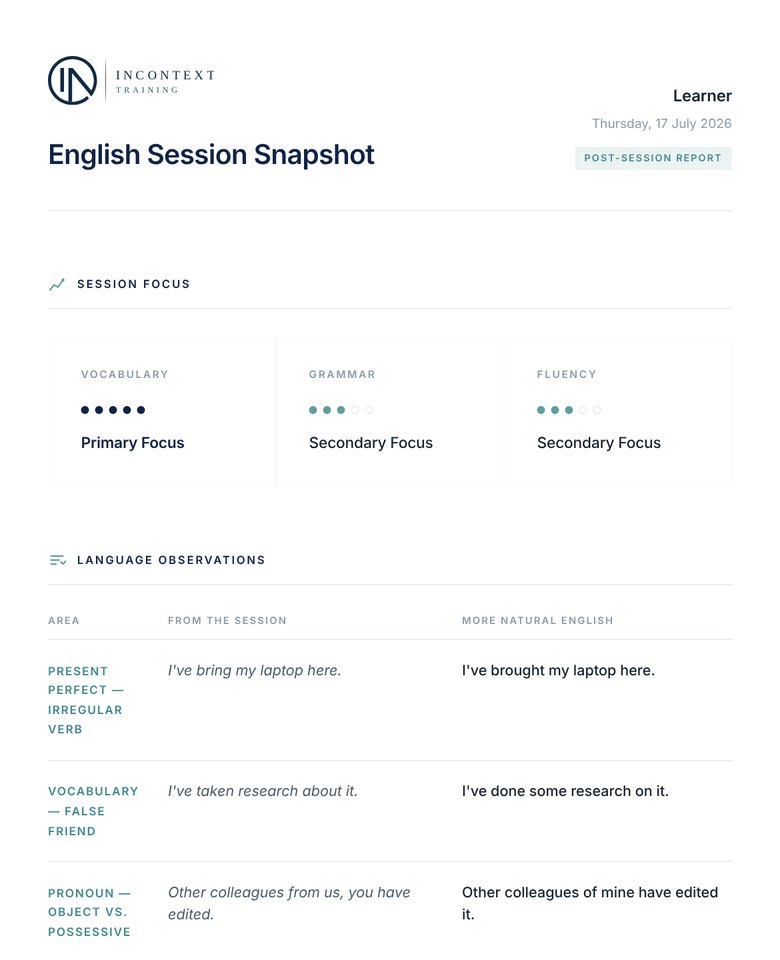
Optional session snapshots record what we covered, so you can review it between sessions, keep track of your progress and plan future development.

A real session snapshot, anonymised: session focus and language observations
Real session snapshot, anonymised
Illustration: a learner speaks with a light gesture while a trainer listens at a small table

Individual training

For professionals, specialists, managers and executives

One-to-one, around your own objectives — adapting quickly to what is coming up in your week.

Illustration: six colleagues, one in a wheelchair, talk informally in a sunlit lounge

Group training

For departments, project teams and international teams

Your team’s real meetings and interactions become the material — not classroom exercises.

Illustration: four senior professionals discuss a decision around a round table

Executive communication

For senior professionals

Support for leadership, stakeholder and international communication — not simply advanced English.

Illustration: a professional presents to two seated colleagues in a quiet alcove

Presentation & meeting support

For a specific moment that matters

Focused help for one moment that matters: a presentation, a meeting you chair, the questions that follow.

Illustration: four colleagues in discussion in a glass-walled meeting room

Sector & role-based programmes

For teams within one profession

Built around how a profession communicates. We learn your environment; we don’t claim technical expertise.

See the professional contexts
Illustration: colleagues in conversation at several tables in a bright arcade

Long-term development

For ongoing partnerships

Communication needs grow with careers. Ongoing partnerships let objectives evolve with new responsibilities.

“We really enjoyed working with InContext. The exercises in the sessions, the content and the materials were all tailored to our company.”
Jennifer N. · HR Development Manager, Dassault Systèmes

02 — Where the work happens

Most of what matters happens in conversation.

An email can be checked before it is sent. A conversation can’t. That is where much of our work happens.

SettingA project meeting. An international team, with English as the shared language.
Who speaksWhat was said · what was understoodTrainer’s notes
ColleagueProject lead, London

“That’s an interesting idea. Maybe we park it for now and see where we are in Q2.”

Understood asThey like it. It’s happening in Q2.
UnderstandingA polite “no”. Softeners like ‘interesting’, ‘maybe’ and ‘park it’ often signal hesitation, not agreement.
LearnerEngineer, Frankfurt

“Great — then I’ll start preparing the Q2 budget.”

Heard asThey didn’t quite follow.
SpeakingAnswers what they thought they heard — and commits to work nobody asked for.
ColleagueProject lead, London

“Well… let’s not get ahead of ourselves.”

Understood asSomething isn’t right.
UnderstandingA second signal. The moment to pause and check, rather than press on.
LearnerEngineer, Frankfurt

“Just so I understand — do you mean we pause it, or that it’s off the table for now?”

Heard asA fair question. Worth an honest answer.
Back on trackCheck, don’t guess. One clarifying question saves time and saves face — now the real conversation can start.

Example

Hearing what’s meant

Tone, softeners and what sits between the words.

Asking to clarify

Checking naturally, without losing face or momentum.

Responding in real time

Thinking and speaking at the speed of the meeting.

Leading with the point

Saying what matters first, so it lands.

03 — Next step

The most effective training for you can only be built around your needs.

Tell us what your team needs

A conversation about your needs, without obligation.